Showing posts with label Fitness. Show all posts

Saturday, March 21, 2015

Facts About Stretching


Stretch before you exercise -- it's an oft-repeated maxim, but the benefits of stretching have not been conclusively proven. The goal of stretching is to prevent musculoskeletal injuries by making soft tissue structures, including ligaments, tendons and muscles, more pliable and less likely to overstretch or tear. Although stretching has become a mandatory part of most sports routines, it might actually increase rather than decrease the risk of injury, in some cases. Stretching might help with some sports and not others. Talk with your trainer or medical provider about the benefits and risks of stretching for you.

Research is Contradictory

Research on the benefits of stretching in preventing injuries has not firmly established a benefit. A Canadian review of available studies published in the October 1999 "Clinical Journal of Sports Medicine" stated that while some studies found a benefit of stretching combined with other warm-up techniques, others reported no benefit and several found that stretching increased rather than decreased the risk of injury. But a University of Alabama study reported in the 2007 issue of "Sports Medicine" claimed that stretching combined with warm-up exercises did help prevent injury. This report states that stretching within 15 minutes before starting an activity had benefit.

Stretching Might Hurt Rather Than Help

The 1999 Canadian study noted five reasons why stretching might increase the risk rather than help prevent sports injuries. The first was that, in animal studies, heat-induced muscle compliance increased the risk of soft-tissue rupture. Researchers also stated that stretching appears to mask muscle pain, which would prevent you from recognizing an injury immediately and stopping an activity. Lastly, researchers explained that stretching can cause damage at the cytoskeleton, or cellular level. Bouncing when you stretch rather than simply holding your stretch for 30 seconds can cause tissue injury Harvard Health warns.

Stretching Improves Flexibility

On the plus side, Harvard Health explains that stretching can improve muscle flexibility, which could help improve your range of motion if you have tightness in structures such as the Achilles tendon. Always warm-up for five to 10 minutes with low-intensity exercise such as light walking or biking before stretching. Don't stretch before a high-intensity workout, such as sprinting, because stretching can decrease rather than increase your performance. Stretch at least two to three times a week to maintain the flexibility benefits of stretching.

Stretching Increases Blood Flow

tretching increases blood flow to your muscles. If you have tissue damage, increased blood flow can increase oxygenation to the damaged tissues and decrease your recovery time. Increased blood flow can also carry away waste products that occur as a byproduct of exercise. Don't stretch to the point of pain and, if you have a current injury, clear any type of stretching with your medical team.


Wednesday, March 11, 2015

5 Benefits of Regular Exercise

Following a regular exercise regime can provide you with numerous health benefits. According to the U.S. Centers for Disease Control and Prevention, or CDC, over 60 percent of U.S. adults don't get enough exercise. The agency suggests performing at least 30 minutes of moderately intense aerobic exercise, such as walking briskly or swimming, on most days of the week to get the health benefits of regular exercise.

Boosts Your Mood

Regular exercise can improve your emotional and mental health by reducing stress and anxiety levels. Exercising stimulates various chemicals in your brain that leave you feeling more relaxed and happier. Regular exercise also helps you get in shape physically, which can boost your self-esteem and confidence. Following a regular exercise routine might also help you to sleep better, which can put you in a better mood as well. Don't exercise too close to your bedtime, however, or you might get too energized to go to sleep.

Improves Cardiovascular Health

Regular physical activity can enhance the health of your heart. Exercising boosts your cardiovascular health by lowering your blood pressure, preventing plaque from building up in your arteries and reducing your triglyceride levels. Physical activity also appears to increase the levels of high-density lipoprotein, or "good cholesterol," in your blood while reducing your risk of stroke.

Prevents Chronic Health Conditions

Regular exercise can decrease your risk of getting type 2 diabetes and metabolic syndrome, a health condition involving high cholesterol, high blood pressure and high blood sugar. People who exercise regularly also appear to have a lower risk of suffering from breast, colon, lung and endometrial cancers, the CDC reports, and the Arthritis Foundation says regular exercise might help you prevent or manage arthritis as well.

Promotes Healthy Weight

Following a regular exercise program is crucial for losing weight and maintaining a healthy weight. You lose weight when you burn more calories than you consume. Exercise helps you to burn off calories while preserving your lean muscle mass. The CDC suggests performing about 150 minutes of moderately intense exercises every week to help keep off excess pounds. Combine regular exercise with cutting your caloric consumption to take off extra pounds.

Increases Strength and Endurance

Regular exercise can help to strengthen your bones, muscles and joints. It can slow down the loss of bone density that can lead to osteoporosis. Older adults who exercise regularly also lower their risk of suffering from a hip fracture if they should fall. Following an exercise regimen increases the strength of your lungs, which means that all of your tissues receive an increased amount of oxygen and nutrients. This oxygen boost gives you more energy.


Thursday, March 5, 2015

The 7 Principles of Fat Loss


Unfortunately, anyone attempting to develop a diet and fitness plan to lose fat and keep it off is swimming against the current these days. There is so much conflicting information about the best way to lose fat that many people are suffering from paralysis through analysis. Do you go low-carb or low-fat? Do you count calories or not? Should you strength train or do cardio -- and what type? Are gluten and wheat really bad for you? What about the Paleo approach? How much protein do you need in a fat-loss phase? It can be exhausting for well-meaning people who want results to sift through all of this information and apply a practical, maintainable and fact-based approach. Read on to learn about the seven foundational fat-loss principles that the world’s leading experts use with their clients to get results.
1. Establish Your Fat-Loss Calorie Requirements
There is a reason this principle is first: If you get this wrong, you can apply the other six principles and experience very little success. Yes, calories do count a great deal. There are different tools and formulas that you can use to track them. To determine your calorie needs for weight loss, simply enter your age, current weight, weight-loss goal, height and gender, and your needs are determined in seconds. The number provided by the tool is your baseline calorie requirement for weight loss. If you’re active or exercise regularly, you can factor in these activities and your calorie needs will increase. Holly Mitchell, an International Federation of Bodybuilding and Fitness figure professional and nutrition coach with Lean Bodies Consulting, cautions against dropping calories too low too fast. “The goal is to see how much you can eat and still lose fat, not how little. If you start out with too large of a caloric deficit and plateau, you’ll have nowhere to go,” she adds.
2. Consume Adequate Protein
Eating enough protein is a critical component of an effective fat-loss plan. Kelly Plowe recommends including protein at meals and snacks for increased satiety and preserving muscle when trying to lose weight. “Getting enough protein in your diet is fairly easy to do with a little effort,” says Plowe. “Try incorporating eggs into your breakfast and yogurt and nut butters into your snacks, and aim to include lean proteins like chicken, fish and beans at lunch and dinner.” A 2013 study of 39 adults looked at the impact of a calorie-deficit diet with three different levels of protein intake -- the Recommended Daily Allowance (RDA), two times the RDA and three times the RDA. While all groups lost weight after 31 days, the loss of fat mass was higher in the two higher-protein diet groups. Mike Roussell, Ph.D., a private nutrition consultant is also an advocate of protein. “It is best to spread your protein intake evenly across your meals while also having a fast-digesting form of protein (e.g., protein shake) immediately after exercise,” advises Roussell.
3. Don’t Fear Carbohydrates
You need not fear carbohydrates because they can help you get more out of your workouts. Mike Roussell, Ph.D., a private nutrition consultant and Shape magazine’s “Diet Doctor,” feels carbohydrates are essential for hard-training individuals. “Eating carbohydrates before or drinking them during training can help you fight fatigue, work harder and burn more fat,” says Roussell. He also points out the importance of post-workout carb consumption because “carbohydrates eaten after you exercise will be preferentially shuttled towards your muscles so that they are refueled for your next training session.”


4. Don’t Attempt to Out-Train a Bad Diet
Trying to exercise off body fat is analogous to trying to drive a nail into a board with a screwdriver. If you bang away long enough, you might get the nail in a little bit, but it would be far more efficient just to use a hammer. In the case of fat loss, proper nutrition is the hammer. Exercising, a combination of strength training and cardiovascular exercise, seven days a week for an hour for the average person will burn about 3,000 calories. That’s less than a pound of fat. That’s a serious time commitment. On the other hand, how much time does it take to not eat those extra 3,000 calories? None. Use a combination of exercise and a good diet to enhance fitness and retain lean muscle mass while losing weight.
5. Prioritize Strength Training
Retaining lean muscle tissue is of paramount importance when in a calorie deficit, and the best way to ensure that happens is by prioritizing strength training. Tony Gentilcore, CSCS, CPT, and co-founder of Cressey Performance in Hudson, Massachusetts, is quick to point out that “what makes muscle keeps muscle.” Gentilcore feels one of the biggest mistakes people make when following a fat-loss plan is underestimating the value of strength training. “The goal should be to maintain as much muscle as possible,” he says. “Adding in more and more training volume, whether it be more cardio or higher-rep resistance training, especially in a caloric deficit, is a great way to lose muscle.” The solution? Gentilcore advises implementing traditional strength work into the mix: heavier loads for five to eight reps per set. “This will not only keep you strong, but it will also provide the stimulus the body needs to keep muscle,” he says.
6. Food Variety Is Not Your Friend
Variety may be the spice of life, but when it comes to fat loss, too much can be counterproductive. Optimal fat loss requires quantification - particularly regarding calories. Incorporating too many foods into your diet can make this quantification tedious, frustrating, impractical and time-consuming. I encourage people to pick four to five sources of protein, fat and starch and build their fat-loss diet around those. This keeps grocery shopping, quantification and meal prep simple. Attempting to incorporate several dozen foods and complex recipes will likely make it difficult to stay on track, and you’ll be spending endless hours in the kitchen. Keep it simple at first. Once you start to develop a routine, you can begin to add in new type of proteins, carbohydrates and fat.
7. Don’t Buy In To Supplement Hype
As much as we want to believe a magic pill, liquid, herb, plant or potion will melt away our fat, the reality is the vast majority of nutritional supplements marketed as fat-loss supernovas are largely ineffective. How can this be, given all the amazing studies these supplements tout? “Two words: mouse and rat,” says Kamel Patel, M.P.H., M.B.A., Ph.D., director of Examine.com. “Many fat-loss supplements have great evidence in animal models, such as the diabetic-rat model, but don’t do so well in human studies,” says Patel. What’s more, you need to follow the money because “human studies are often poorly designed and funded by the supplement manufacturer,” adds Patel. He also points out that even supplements that have a minor positive effect burn far fewer calories than just a few minutes of exercise, and they can have adverse side effects such as insomnia and jitters. Lastly, the supplement industry is loosely regulated, so often claims are made without sufficient substantiation or regulation of the product’s contents.

                                              Billy Blanks - Tae Bo T3 Transformation
                                                    

Sunday, July 13, 2014

A 5K Training Plan For Beginners

You’ve been running. It feels good, maybe a little hard, but it has prompted you to flirt with the idea of entering a 5K.
Good choice. The 5K (3.1 miles) is every runner’s distance. It’s fun and doable, and if you’ve been walking, running, or run-walking 2 to 3 days a week for at least two months, you’re ready. Sure, building your mileage will feel tough, and there’ll be days when you don’t feel like running, but the reward is real—and we don’t mean the t-shirt. The training itself gives back: you’ll feel fitter, stronger, and amazed that a distance or pace that used to be hard actually feels comfortable.
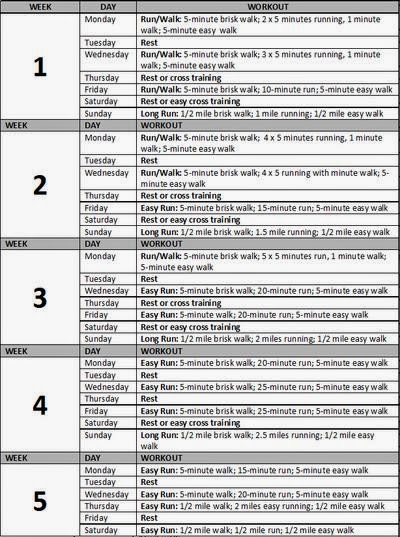
Your first step is to sign up for a race at least five weeks away. That’ll give you enough time to follow our training program, created by Andrew Kastor, coach of the High Sierra Striders in Mammoth Lakes, California. His plan builds from an easy run/walk to 2.5 miles of steady running—giving you the distance you’ll need to hit the big 3.1 on race day. Each week, you simply increase the amount you run.
THE PROGRAMYOUR GOAL: Finish your first 5kYOU’RE READY IF: You’ve been running, walking or run-walking 2 to 3 days a week for at least two months. There are four day of running, with a rest or cross training day in between. “The every-other-day schedule minimizes the risk of injury, and provides a mental break,” says Kastor. Alternate running days also ensures rest days fall on weekdays and weekends, so that the plan can fit into your work and family life.


TIME VS. MILES: It’s easier to time your runs than clock the mileage, so weekday workouts are all done by the clock. Sunday’s run is in miles so that you can begin to gain a sense of your pace per mile. “Mile workouts are also confidence builders,” says Kastor. “Knowing how far you’ve run offers assurance that you can cover the distance on race day.”
WORKOUT KEY

WARM UP/COOL DOWN: Each run begins with 5 minutes of brisk walking, and ends with 5 minutes of easy walking. You’ll be tempted to skip these, but don’t. Warming up and cooling down safely transition the body into and out of exercise, explains Kastor, but the walking segments also increase your total workout time, which helps build the endurance you’ll need on race day.
INTENSITY/PACE: All runs should be done at an easy effort: a conversational pace, 60-65% of max heart rate, or a 5 on a rate of perceived excursion scale (of 1 to 10). Faster, harder running increases injury risk, says Kastor. Use your first race to build endurance, then if you want, you can start playing with speed.
RUN/WALK: During the first two weeks, the workouts alternate running with a minute of walking. So “2 x 5 minutes running, 1 minute walk” means you’ll run for five minutes, walk for one, then repeat. “3 x 5” means you do that three times. Don’t consider the walking breaks wimping out. Nearly 80 percent of runners get injured; walking breaks are a strategic tool to build distance safely. Plus, they make adapting to running easier and more enjoyable.
EASY RUN: These workouts are steady runs done at a comfortable pace. If you’re struggling to finish the workout, slow down.
LONG RUN: Long runs build the base of distance running: endurance. They are a road-racers most important workout. If you don’t live near a walking path that has miles marked, measure the distance in your car, head to the track (4 laps equals a mile), or use U.S. Track and Field’s mapping tool (usatf.org/routes) . Time your first mile workout. You can then estimate the time it will take you to finish the other long runs, or of course, you can map those out too.
REST/CROSS TRAIN: Rest days are full days off (no workout). Cross training is an option; you can do yoga, swim, bike, hit the gym, any workout you enjoy. The added exercise will boost your running—just keep it easy the day before your long run so that you don’t start this key workout fatigued.
DAYS OF THE WEEK: Plans change sometimes. If you need to rearrange training days, go for it. Just shift the days forward or back, or do your best to preserve the every-other-day plan.

FOR MORE WORKOUT VIDEOS, CLICK HERE !

Thursday, July 3, 2014

Core Strength Training Workouts

Your core provides strength and stability for the rest of your body, which is why it is important to develop these muscle groups. The core not only consists of the rectus abdominis and transverse abdominis, better known as the abdominal muscles, but it also includes the obliques, lower-back and glutes. A great core workout needs to address each area and from multiple angles to get a toned six-pack and a powerful midsection.

Crunches

While crunches shouldn't be the only exercise that your core workout plan consists of, the basic crunch, and modifications of it to add difficulty, is a good starting point to target the abdominal muscles. Begin by lying on your back with your feet flat on the ground and your knees bent. Your heels should be about 12 inches from your bottom. Put your hands behind your head and keep your elbows out to the sides. Engage your abs to curl your head and shoulders off of the ground and lift your torso toward your knees until your upper back is off the ground. Slowly lower your torso back to the ground to complete one rep. Extend your arms over your head to make the exercise more difficult. Do two to three sets of 10 to 12 reps with 45 to 60 seconds of rest between each set.

Standing Cable Rotation

The standing cable rotation works many of the core muscle groups including the abs, obliques and lower back with it's side-to-side, twisting motion. This exercise needs to be done with a piece of resistance tubing or cable machine. Start with your feet hip-width apart, standing alongside either the cable machine or the resistance tubing. Hold the cable close to your body just under your chest. Twist away from the cable by moving your head, chest and torso together. Hold for a moment and then return to the starting position. Extend your arms to increase the intensity of the exercise. Do two to three sets of eight to 12 reps for each side, resting for 45 to 60 seconds between sets.

Stability Ball Knee Tucks

Work your abs, lower back and glutes with stability ball knee tucks. Begin in the pushup position with your shins resting on top of the stability ball. Draw your legs in towards your chest while pulling the stability ball in as well. Keep your arms and shoulders locked to stabilize your upper body. Squeeze your glutes and extend your legs back to the starting position to complete one rep. Do two to three sets of eight to 12 reps.

Rolling Side Plank

This exercise targets the abs and obliques while also working the entire core. Begin in the plank position by resting on your forearms with your legs extended behind you. Rotate onto your left forearm so that you are in the left side plank position. Hold for a moment before returning to the starting position. Hold this position for a moment and then rotate onto your right forearm so that you are in the right plank position. Hold and then return to the starting position. Continue this pattern for 45 seconds.


FOR MORE WORKOUT VIDEOS, CLICK HERE !

Wednesday, July 2, 2014

4 Ways to Spot Your Weaknesses

If you were a Hollywood celeb or star athlete, you wouldn’t have to think about your workout. You could pay big money to hire a world-class trainer to do that for you.
But if you’re like most of us, you are the person in charge of your lifting plan – choosing your exercises, setting goals for sets and reps, and figuring out how to cram it all into the limited free time you have to hit the gym. So how do you design a workout that best meets your needs?
Thankfully, it’s easier than you think. The following series of simple moves will help you determine your strengths and weaknesses. Once you know the areas where your body is powerful (and where it needs work), you can choose exercises to help you reach your fitness goals.
It’s important to understand how well your body performs the most basic of motions: bodyweight squats, pushups, overhead reaches and lunges.

Self Assessments: Your Starting Point
Whether you’re a seasoned workout warrior or gym newbie, it’s important to understand how well your body performs the most basic of motions: bodyweight squats, pushups, overhead reaches and lunges.
These moves will tell you a lot about how stable and how mobile you are. If you’re stable, you’re in control. If you’re mobile, you have the range of motion to perform exercises with proper form. If you’re wobbly, shaky or just can’t fathom how your hips could ever sink into a squat, you’ve just discovered an area for improvement.

Assessment 1: Bodyweight Squat

The Test: Stand facing a wall with your legs a little more than shoulder width apart. Descend into a squat. Keep your torso upright, with your knees tracking over your toes. If you fall forward or your knees buckle inward, you’ve got a problem. Either your ankles, hips or upper back don't have enough flexibility to perform the squat, or your core doesn't have the strength to remain upright.
The Fix: To address mobility issues in your lower body, you want to open up your hips with exercises such as striders. You can also improve flexibility in your upper back by performing thoracic extensions on a foam roller. Lastly, you should do some planks to strengthen your core.
Striders: Start in a pushup position with your legs, glutes and upper back tight. Lift your right leg and bring your right foot to the outside or your right hand. Return to the starting position and repeat on the left side. Keep your entire body in a straight line during the movement – don’t let your hips drop. Perform up to three sets of eight to 12 repetitions for each leg.
Thoracic Extensions: Lie with a foam roller underneath your back about halfway between your shoulders and hips. Your hips should touch the ground. Tuck your chin but do not stretch your neck, and keep your hips pressed against the ground as you extend over the foam roller as far as you can. Then bring your chin back upward, as if you were doing crunches. Perform two sets of eight to 12 extensions.
Plank: Start either on your hands in a typical pushup position or on your forearms if you find the pushup position too challenging. Tense all of the muscles in your body, including your back, core, glutes and lower legs. Hold this position for one to two minutes. Do up to four sets.

Assessment 2: Pushups


The Test: Set up in the top of a pushup with your arms locked. Lower yourself with control, tucking your elbows in toward your sides. Bend your elbows to 90 degrees, then reverse the movement and drive back upwards to the starting position. Perform 10 repetitions, paying particular attention to the following: Does your back remain straight? Were your shoulders wobbly? Did your elbows flare outward? If so, your triceps are weak or you don’t have proper engagement in your core and back to perform the exercise.

The fix: If the problem was in your core, the fix is simple – add planks to your workout. If the instability felt rooted in your shoulders, try face pulls, which strengthen the shoulder retractors and external rotators. And if your elbows flared outward, dumbbell military presses will help.

Face Pulls: At a cable resistance machine, position a two-handled rope at the highest setting. Grab each end of the rope with an overhand grip and take a step back so that you feel tension on the rope. Your feet can be together or you can use a split-leg stance. Keep your posture straight as you pull each end of the rope in straight line toward your face. Use a lower weight for this exercise and focus on form. Do up to three sets of 12 to 15 repetitions.

Dumbbell Military Press: Stand with a dumbbell in each hand, held at shoulder height. Engage your torso so that your abs, lats and even legs are all supporting you as you push both dumbbells upwards. Your arms should be fully extended at the top. Lower the weights back to your shoulders and repeat. Perform up to four sets of six to12 reps.

Assessment 3: Overhead Reach


The Test: Stand upright with your feet parallel and positioned about shoulder width apart. Your hands should be at your sides with your palms facing inward. Engage your core – don’t let your ribs flare out -- and lift your arms forward, drawing a half-circle in front of you until your hands are over your head, your arms are straight and your thumbs are pointing behind you. Keep your back straight, and don’t let your lower back hyperextend. If you are unable to reach fully overhead, it’s an indication of poor upper back mobility, a weak core and even potential issues in your hips.

The Fix: This assessment goes hand in hand with the squat assessment, and tells you a lot about your shoulder mobility and posture overall. Many lifters have internally rotated or slouched shoulder posture, which the overhead reach will point out immediately. If your shoulder flexibility is less than you’d like, address it with shoulder stretches on a squat rack. For mobility problems in your back, try some foam roller work. Lastly, use squat-to-stands to fix any issues in your hips.

Shoulder Stretches: Find a squat rack or power cage, bend your arm 90 degrees at your elbow and place your forearm against one of the racks. Turn your torso away from your arm. Keep your trunk in a neutral position with your shoulders and hips parallel as you turn. You should feel a stretch in the front of your shoulders and across your chest. Repeat on the other side. Hold each stretch for 10 to 15 seconds. Do three to four sets.

Foam Roller: Roll back and forth on the foam roller, working out any tightness in your middle to upper back. Roll for 30 to 60 seconds, and do up to three sets. Then turn to your side, keeping the foam roller perpendicular to your torso, and roll out your triceps and lats. Move slowly and deliberately, taking deep breaths whenever you feel discomfort. Repeat the routine on your other side.

Squat-to-Stands: Grab the tops of your toes while trying to keep your back as straight as possible. Squat down, driving your knees toward the outside of your arms. Continue to hold on to the tops of your feet as you extend your hips back up. When you feel tension in your hamstrings or glutes, lower yourself back down. Repeat this pattern for up to two sets of eight to 12 repetitions.

Assessment 4: Lunges


The Test: Start by standing upright and take a step forward with your right leg. Plant your right foot squarely on the ground, shifting most of your weight into your right heel.

Lower your body, keeping your torso erect until both your back leg and front leg are bent at 90 degree angles. Your back foot should be up on your toes, and your left knee should just barely be touching the floor. Stay in control as you step forward with your left foot, bringing it directly alongside your right leg. Repeat on the other side. Throughout the routine, your hands can either be at your sides or pressed together in front of your chest.

If you have a tendency to shift side to side, or your front knee is falling forward of your toes, it indicates immobile hips or ankles.

The Fix: Work on the mobility of your ankles with a simple ankle mobility drill.

Ankle Mobility Wall Drill: Stand about one foot away from a wall with your feet flat. Keep your heels down, and drive your right knee forward, trying to touch the wall. Repeat on the other side. Perform eight to 12 repetitions for up to three sets.

Hip Thrusts: Your instability on lunges could be an indication of a weakness in your posterior chain -- the backside muscles including your glutes and hamstrings. Because of immobility and misalignment in your hips, your glutes typically don't work the way they should, which negatively affects your stability. Performing hip thrusts will reactivate your glutes and provide a dynamic stretch on your hips flexors on the front side of your hip.

Lie face up with your upper back on a flat bench and your feet flat on the floor. Keeping your torso and head in a straight line, lower your hips toward the floor. Then reverse the movement by powerfully contracting the glutes and thrusting your hips upward, extending your hips until your knees, hips and torso are in a straight line.


FOR MORE WORKOUT VIDEOS, CLICK HERE


Tuesday, July 1, 2014

16 Gym Etiquette Rules That People Often Break

Gyms don’t always hand out a “Rules of Conduct” book when you join. You’re simply expected to act like a decent human being, clean up after yourself and generally behave. Problem is, common sense doesn’t necessarily reign in every fitness facility. Here are the most common and most aggravating gym missteps, according to experts who spend the most time in those environments. From smelling too good, to filling up a giant size water bottle when there is a line of people behind you. Read on, to see if you’re guilty of any of these 16 major gym etiquette pet peeves. Let us know which one annoys you most, and if there are others that should be on our list.
1. If You’re Sick, Stay Home
Coughing and sneezing during in a fitness class or while lifting weights leaves a trail of nasty microbes waiting to infect the rest of the gym. According to Jessica Matthews, exercise physiologist with the American Council on Exercise, in general it’s okay to exercise with “above the neck” symptoms like a sore throat or runny nose. “But in fairness to your non-sick fellow fitness fanatics,” Matthews explains, “if you’re going to get some exercise in while you’re battling a cold, you should opt for an at-home workout — perhaps your favorite fitness DVD or an outdoor workout.” If you do choose to work out at the gym, be respectful of others and be sure to properly sanitize all equipment that you use — which you should always do, sniffles or not.
2. Obey Cardio Time Limits
During busy times of day many gyms limit cardio sessions on machines, usually to 20 or 30 minutes. Refusing to step off after your designated time impacts the person waiting behind you and simply isn’t fair. “Cardio machine time limits are put in place for a reason, as they ensure the opportunity for every exerciser to make the most out of their time at the gym, especially during peak hours,” says Mathews. You want to train smarter, not longer, so if you’re hopping on the elliptical with a 30-minute time limit, make the most out of the time you have by kicking up the intensity with intervals. Many studies show these shorter workouts burn more calories for hours afterward.
3. Don’t Be a Creeper (AKA Focus on Yourself)
Let’s face it, every gym has people who flirt. Spandex, sweat and all that heavy breathing can make it tempting to stare and hover over your neighbor’s treadmill. Don’t. “When you’re at the gym your time should be spent focusing on your own workout,” says Matthews, “not anyone else’s.”. You should be paying attention to what you are doing (or what you’re lifting). This not only ensures that other exercisers feel comfortable in your presence, but it can help you to avoid injury and make the most out of your time spent at the gym.
4. Dress Appropriately
Short-shorts, barely-there tank tops and loose, baggy clothes that get caught in a machine can all constitute fashion hazards for various reasons. “While the clothes don’t necessarily make the workout, the right apparel can definitely enhance your exercise experience and help you to avoid any unwanted attention,” says Matthews. Wearing clothing that provides appropriate coverage and the right fit to allow you to do everything from jump squats to downward facing dogs with confidence and ease. If you’re clothing is too tight can restrict your range of motion, which can make your form suffer, says Matthews. Baggy clothing and/or too-long pants can get caught or snagged on something or you can trip over them and injure yourself.
5. Smell Good, Not Great
When your aroma –good or bad– enters the room before you do, it’s time to make some adjustments. “Leave fragrances and colognes for outside the gym,” says Matthews, “but please use deodorant.” Heavy fragrances and perfumes can be distracting to your fellow fitness class goers and can even trigger allergic reactions in some individuals. Strong body odor can also be very unpleasant, so either shower and/or swipe on deodorant before breaking a sweat. Matthews also recommends not using greasy lotions before you hit the gym. Once you begin to sweat, creams can make your skin slippery, making it difficult to hold your favorite arm balancing posture in yoga or properly grip and hold on to a barbell or kettlebell — which could put you at risk of injury.
6. Keep Unsolicited Advice to Yourself
No one likes being told what to do, especially from a know-it-all stranger. Even if you’re a trainer, unless you’re working at that gym, keep your opinions to yourself. “If you are not a certified fitness professional —and an employee of the facility that you are working out at— offering up fitness advice is not in your job description,” says Matthews. If you see someone performing an exercise that puts them in danger or at risk for injury over time and you are legitimately concerned, immediately flag down the nearest trainer on staff and let them know about what you observed. A qualified trainer knows how to approach people in a positive, productive manner to make the gym member feel safe, not “picked on” or embarrassed.
7. Don’t Use the Water Fountain to Refill Your Giant 64-oz Bottle
Staying hydrated during your workout is important, especially on hot days. But standing in front of the water fountain refilling your gallon size bottle creates a bottleneck of thirsty gym members waiting in line behind you. Follow the rules of the road, says Guy Andrews, MA, CSCS, executive director of Exercise ETC, Inc., a fitness education program provider in Fort Lauderdale, Fla. “Yield the right of way. Step to the side so people who want a fast gulp or two can get back to working out. And to avoid spreading germs don’t touch the spigot of the fountain to the mouth of your bottle.”
8. Keep Your Gym Bag in a Locker, Not at the Feet of Other Exercisers
The only thing worse than dropping a weight on your foot is doing it because you tripped over someone’s gym bag lying on the floor. “Leaving a bag on the floor is a major tripping hazard, which is why all gyms prohibit it,” says Andrews. Use the lockers inside the locker room or near the workout area. “If you’re afraid that your locker may be broken in to leave the stuff in your car,” says Andrews. You can also keep any valuables on you: Fanny packs may be tacky but they’re functional, says Andrews. Better yet, strip down to the essentials: carry your I.D., phone, keys and maybe one debit card on your person and leave the rest at home.
9. Don’t Train Right in Front of the Weight Rack
Normally the person lifting weights has the right-of-way. But when you choose to perform one-armed rows with one hand on the rack, or you grab two dumbbells for biceps curls and step back only two inches, you prevent others from accessing the weights. “It is invariably a high traffic area where you risk blackening the eye or breaking the nose of some nice gym-goer who is just trying to access the weights,” says Andrews. Your best bet is to grab the weights you need and retreat to an area where you can exercise but still not obstruct traffic. And remember to re-rack them when you’re finished with your set.
10. Respect Other Peoples’ Desire for Quiet
Stay off of your phone. No one wants to hear your conversations. Plus, your gym time should be your time to cut the cord for an hour or so, says Andrews. “There are times when making or taking a call is necessary, but it should not be standard operating procedure for you.” Exceptions include a work crisis or a phone call from your wife or husband telling you the house is burning down. In that case, exit the training area to make your call. You’ll probably have better reception and more privacy outside, and the people around you will appreciate it.
11. Don’t Read While on a Machine or Otherwise Occupy it Between Sets
For the sake of time and fat-burning efficiency, you shouldn’t be resting much between sets. If you’re performing intervals or some other high intensity workout where you take a minute or two between sets, don’t rest up by taking space on a machine others may want to use. “If your rest time between sets is more than 10 seconds, you need to vacate the machine when other people are waiting, or at least ask if they want to work in,” says Andrews. “Besides, short rest periods between sets are associated with a higher exercise heart rate, increased caloric burn, higher metabolic rate, increased muscle fiber recruitment and a significant boost for anabolic (growth) hormones.” Get moving.
12. Don’t Hog Equipment
Super-setting by working out on 2 or more different pieces of equipment prevents others from using them. It’s a no-can-do when others are waiting to work out. According to Tom Holland, MS, CSCS, exercise physiologist based in Connecticut and author of “Beat the Gym,” leaving your towel hanging on a machine doesn’t give you “dibs” on that piece of equipment. “You can’t have 3 or 4 exercises going on at once spread out over several weight benches to do your super sets. Put your weights back on the rack and bring your towel with you. Trainers that work in gyms are guilty of doing this sometimes as well.” Holland recommends super-setting by staying on one bench. For example, superset an upper body move with an ab exercise done on that same bench.
13. Unload Your Weight Bar
News flash: Your mother doesn’t work at the gym to pick up after you. So, be a sport and don’t leave a bar or machine with full racks of 45-pound plates. The next person after you now has to remove all your poundage before he or she can even begin. Removing your weights off the bar is part of your workout, says Holland. “It’s usually the person lifting a ton of weight who’s most guilty of this maneuver. In addition, if you leave the weights on other people don’t know whether or not you’re finished using the equipment.” If you know the culprit who makes this a regular habit, don’t take matters into your hands, says Holland. Go to management and tell them. They should be the ones to lay down the law.
14. Re-rack Dumbbells
Failing to re-rack your dumbbells is as dangerous as leaving your gym bag lying on the floor. In addition to the tripping danger, the next exerciser will need to search for the weights if they’re not in their proper location on the rack. “It’s rude and dangerous,” says Holland. “Re-racking your weights is part of your workout. It’s so simple.” This also pertains to weight plates. Leaving a 45-lb plate leaning against a machine because you’re too lazy to re-rack it is just as dangerous as leaving a dumbbell out on the floor — and it can roll at an expected time.
15. Wipe Down the Bench and Use a Towel
Many gyms require you to use a towel when you work out, and with good reason. It’s more than just gross to lie in someone else’s sweat, but -- although the risk is low -- you could end up infected with MRSA, staphylococcus aureus. Always use a protective barrier between you and the bench, whether it’s a towel or shirt, and wipe down any surfaces with antiseptic wipes before or after use. And always shower and wash your hands immediately after your workout.
16. Don’t Block Traffic
It’s bad enough to deal with bottlenecks on your way to work, so navigating around oblivious people at the gym can be just as annoying. And it slows down your workout! Failing to re-rack your weights and plates, working out in front of the rack and walking in front of exercisers who are using the mirror (checking their form, not their hair) creates roadblocks and distractions and increases the chances that someone will get hurt. The National Strength and Conditioning Association’s (NSCA) safety checklist for exercise facilities recommends easy access to each resistance training machine area, allowing a minimum of two feet between each machine and three feet as optimal for safety. Obey the rules for a safe and effective workout.


FOR MORE WORKOUT VIDEOS, CLICK HERE !